
Why Are Communication and Confidence as Important as Academic Knowledge?
September 25, 2026
Introduction
Think back to the person you’ve ever met. Not the one with the best marks necessarily but the one who genuinely knew the most. Now think about whether they were the one whose ideas got heard whose projects got approved whose opinion carried weight in a room. Often the answer is no. Knowledge without the ability to express it clearly or the confidence to put it forward all tends to stay locked inside a person doing very little good for anyone. This is a gap that shows up again and again in classrooms. Its something educators at Sunbeam International School ICSE think about as seriously as they think about exam results.
Academic knowledge answers the question “what do you know?” Communication and confidence answer a equally important question: “can you actually use it?” A answer that never gets voiced a good idea that gets talked over a well-prepared student who freezes in an interview. These aren’t failures of intelligence. They’re failures of expression and self-belief. They’re entirely fixable with the right kind of practice. Here’s why these two qualities deserve as much attention as textbook knowledge and how schools can actually build them.
Knowledge Only Creates Impact When Its Communicated
A student can understand a concept perfectly and still fail to convey it. To a teacher an examiner, a future employer or a room full of strangers. The gap between knowing something and being able to explain it is bigger than most people assume and it’s a gap that academic scoring alone rarely tests.
Written knowledge versus understanding
Plenty of students can write a flawless answer under exam conditions but struggle to explain the same concept out loud in their own words without notes. Verbal explanation forces a kind of processing. One that reveals whether understanding is genuine or memorised and one that matters far more in real workplaces than written recall does.
Clarity as a skill, not a personality trait
Some people are naturally more articulate. Clarity in communication is trainable not innate. Structuring an argument avoiding jargon and getting to the point are all skills that improve significantly with deliberate practice. Presentations, debates, structured discussions. Rather than something students either have or don’t.
Listening as half of communication
Good communicators aren’t good talkers; they’re good listeners who respond to whats actually being said rather than what they assumed would be said. Group discussions and collaborative tasks that reward listening. Not just the loudest voice in the room. Build this half of the skill, which schools sometimes overlook entirely.

Confidence Determines Whether Knowledge Gets Used at All
Here’s a truth: in most classrooms and later in most workplaces the person who speaks up. Even imperfectly. Often gets more credit than the person who stays quiet with a better answer. Confidence isn’t about being the person in the room; it’s about being willing to put forward what you know even when theres a risk of being wrong.
The cost of staying silent
A student who knows the answer but doesn’t raise their hand again and again over years quietly learns that their input doesn’t matter. A lesson thats hard to unlearn. Building confidence early prevents this pattern from calcifying into adult life, where the stakes of staying silent’re considerably higher.
Confidence built through repeated low-stakes practice
Nobody becomes confident by being told to ” believe in yourself.” Confidence comes from doing something. Presenting, debating, answering questions in front of others. Times that the fear shrinks with repetition. Schools that create low-pressure opportunities to speak and be heard are doing more for a students future than any single motivational talk ever could
Handling being wrong in
A huge part of confidence is simply being okay with getting something wrong in front of others and continuing anyway. Students who never practise this in a school environment often experience it for the first time in a job interview or a client meeting. A far higher-stakes place to learn it for the first time.
How Schools Can Deliberately Build Both
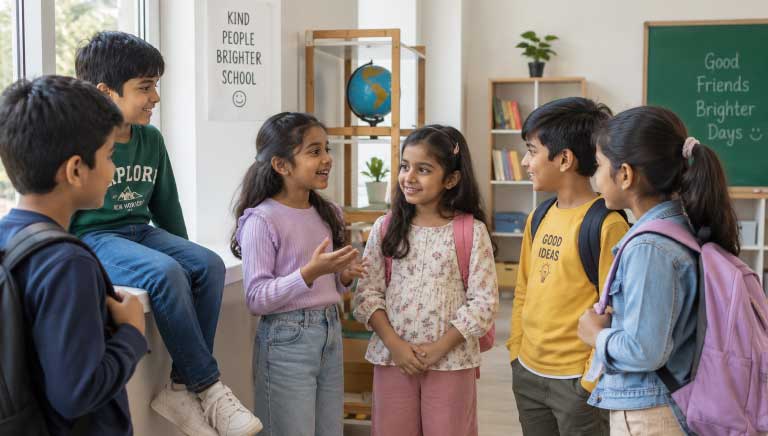
Communication and confidence don’t develop by accident in a handful of students while everyone else misses out. They develop through structure. Opportunities, real feedback and an environment where speaking up is treated as normal, not exceptional.
Regular platforms to speak and present
Debates, elocution, class presentations and student-led sessions give every student. Not just the naturally outspoken ones. Repeated reps at expressing themselves in front of others. The more normal this becomes on the less intimidating it feels later.
Feedback thats specific, not just encouraging
praise (“well done!”) doesn’t build skill the way specific feedback does (“that argument would land better if you led with your strongest point”). Students improve fastest when they know what to adjust not just that they should feel good about trying.
A culture where every voice gets space
Knowing your reactions managing stress and reading the room are skills that influence every part of a student’s life from teamwork to leadership to mental well-being. Sunbeam International School ICSE treats this area as not optional because an academically strong student without self-awareness is only partly ready for the future.
Being future-ready is not about predicting the shape of tomorrow. No one can do that. It is about giving students thinking, practical skills and steady character so they can manage whatever future comes. That mix is stronger than any piece of knowledge or trendy skill.
Conclusion
This is exactly why Sunbeam International School ICSE treats communication and confidence-building as core to the classroom experience, not an occasional extracurricular add-on. Because, at Sunbeam International School ICSE the goal has never been just to produce students who know a deal. It’s to produce students who can stand up speak clearly and be heard.
– SBIS Editorial team
Quick Links
Newsletter
© 2024 - Sunbeam International School. All Rights Reserved.